What is a Geodesic Dome?
- Jacki B.
- Apr 28
- 3 min read
Hello, Gardening Friends!
In the last post, we talked about a season-extending structure that could handle the aggressive, and sometimes rude, SE Wyoming winds. They are called Geodesic Domes, and the University of Wyoming has written a building manual so we can build them ourselves (see the link for the publication). But what is it? I am going to be honest...I am going to do my best to put this in my own words and explain it the best I can, but I am taking help from the same manual that I have linked for you. This is really for those who don't have time to read 216 pages of geometric fun!!!
As I have been writing this post, I realize we are about to take an international trip. Shall we travel? Let’s start at the beginning. Anyone here remember their Latin and Greek lessons? No? Let me help you out! It really sounds Greek to me, as the origin of geodesic came from the islands of Greece. "Geo" as we know, means earth, like geography (the study of the earth) and geometry (the study of points, lines, angles, surfaces, and solids). Who here remembers Geometry? Yeah, I can do it but don't ask me to memorize theorems, please!!! According to The University of Wyoming, A Users’ Guide to Building a 22-ft Diameter 2V Geodesic Dome, geodesic means "to measure the earth."
Off we go to Italy next! Leonardo Da Vinci came up with a way to connect structures that supported themselves without the need to strap the pieces together. Some of his designs went into cathedrals, such as in this picture:

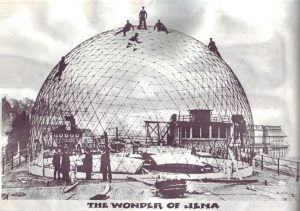
Our journey continues to Germany where an engineer named Walther Bauersfeld (1879-1959), is "credited with building and patenting the first modern geodesic dome" when he decided in 1919 a new style of planetarium was needed to understand the universe. Because of a little incident called World War II (trust me, this is in jest...it was not so little), Bauresfeld's work was often overlooked by the western world.
As we arrive in America, an architect named Richard Buckminster Fuller, who was known as a lover of futuristic designs, "rediscovered" (thank you again UW Extension!) Bauersfeld's design. Fuller figured out how to connect strips of materials to create a web of circles and called it what we know today as a geodesic dome and made it a popular architectural feature (https://ekodome.com/the-history-behind-geodesic-domes/).
So, we have journeyed across time and space to understand where the dome came from, does anyone want to delve into what it actually is? According to our faithful building manual, a dome requires the use of various triangles sizes and multiple compound angles. Math, anyone? Specifically, that "G" word I used earlier...Geometry? Well, lucky for us, educators with lots of letters behing their names have done a lot of the math for us. And I, for one, appreciate it!!!
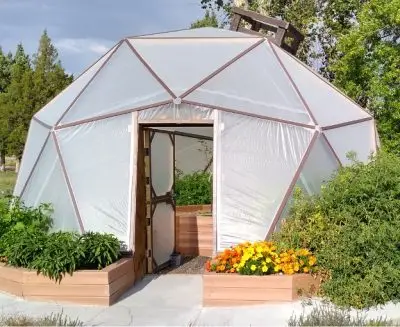
In the end, what is a geodesic dome? It is a wind-resistant, rounded structure that has the ability to protect plants in Laramie County and SE Wyoming. In the Laramie County Master Gardener Demonstration Garden, we will have 5 of these structures, eventually, along with Climate Batteries. What is a Climate battery, you ask? On the nest installment of extending our season.... Until then, Happy Gardening Friends!